
A Decoupling Calculator You Can Run on Paper
If you and your spouse have been thinking about buying a second property, you have probably already come across the term decoupling. Simply put, decoupling means one spouse sells their share of the current home to the other, so the exiting spouse can make the next purchase without owning any residential property.
Decoupling is not just a paperwork exercise. You are genuinely transferring part of the property, which means stamp duty, two law firms and a valuation report can all come into the picture.
Our guide to property decoupling in Singapore covers how it works and where things can go wrong. Here, we are focusing on the numbers.
For a typical 50-50 decoupling on a $1.5 million condominium, you could be looking at around $23,000 to $25,000 in duties and fees. So where does that money actually go?
Let us break it down with three example couples and see how the numbers add up.
The four lines on every decoupling bill
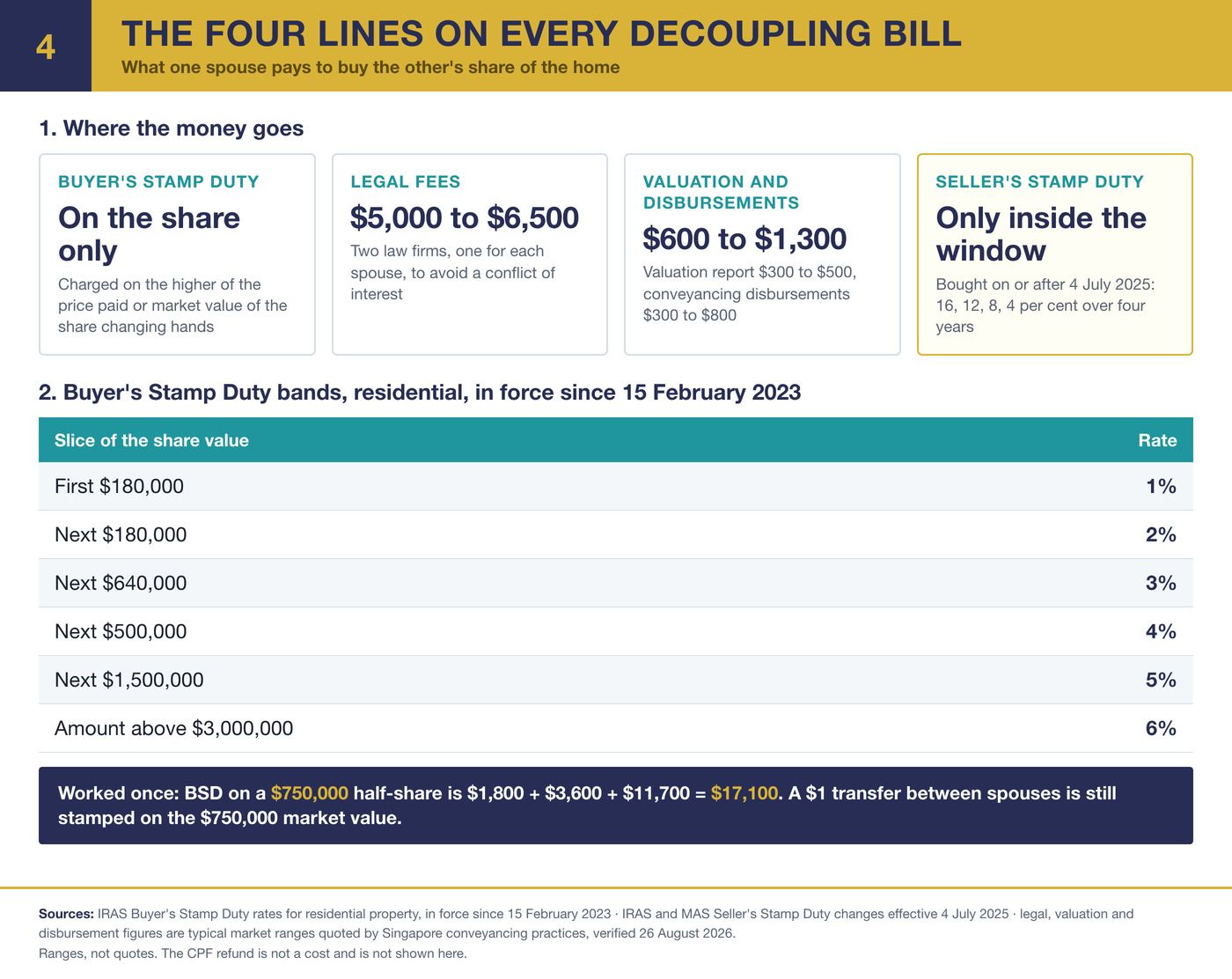
Most decoupling costs come down to four things: Buyer's Stamp Duty, or BSD, on the share being transferred, legal fees for both law firms, the valuation and registry costs, and sometimes Seller's Stamp Duty, or SSD.
The important part is how BSD is calculated. It is based on whichever is higher, the price you pay for the share or its market value.
So a $1 transfer saves nothing. Nice try, but the Inland Revenue Authority of Singapore, or IRAS, has already thought of that.
Here are the current BSD bands for residential property, in force since 15 February 2023.
| Slice of the share value | Rate |
|---|---|
| First $180,000 | 1% |
| Next $180,000 | 2% |
| Next $640,000 | 3% |
| Next $500,000 | 4% |
| Next $1,500,000 | 5% |
| Amount above $3,000,000 | 6% |
Legal fees come next. You can expect to pay around $5,000 to $6,500 in total, because you and your spouse need to engage separate law firms to avoid any conflict of interest.
You will also need a valuation report, which typically costs around $300 to $500. On top of that, allow another $300 to $800 for conveyancing disbursements and other legal costs.
So when you are budgeting for a decoupling, do not just look at the stamp duty. These legal and valuation costs can easily add another few thousand dollars to your total.
The refund to the Central Provident Fund, or CPF, is not really a cost to you. The money goes back into the exiting spouse's own CPF account.
However, the refund still affects your cash flow. You may need to account for it when working out how much cash you actually need for the decoupling, and the examples below show you exactly how this can play out.
When we help couples work out the cost of a decoupling, we usually start with the valuation report. You need to know the value of the share being transferred first, because that figure affects almost every cost that comes after it.
A $1.5 million condo held 50-50
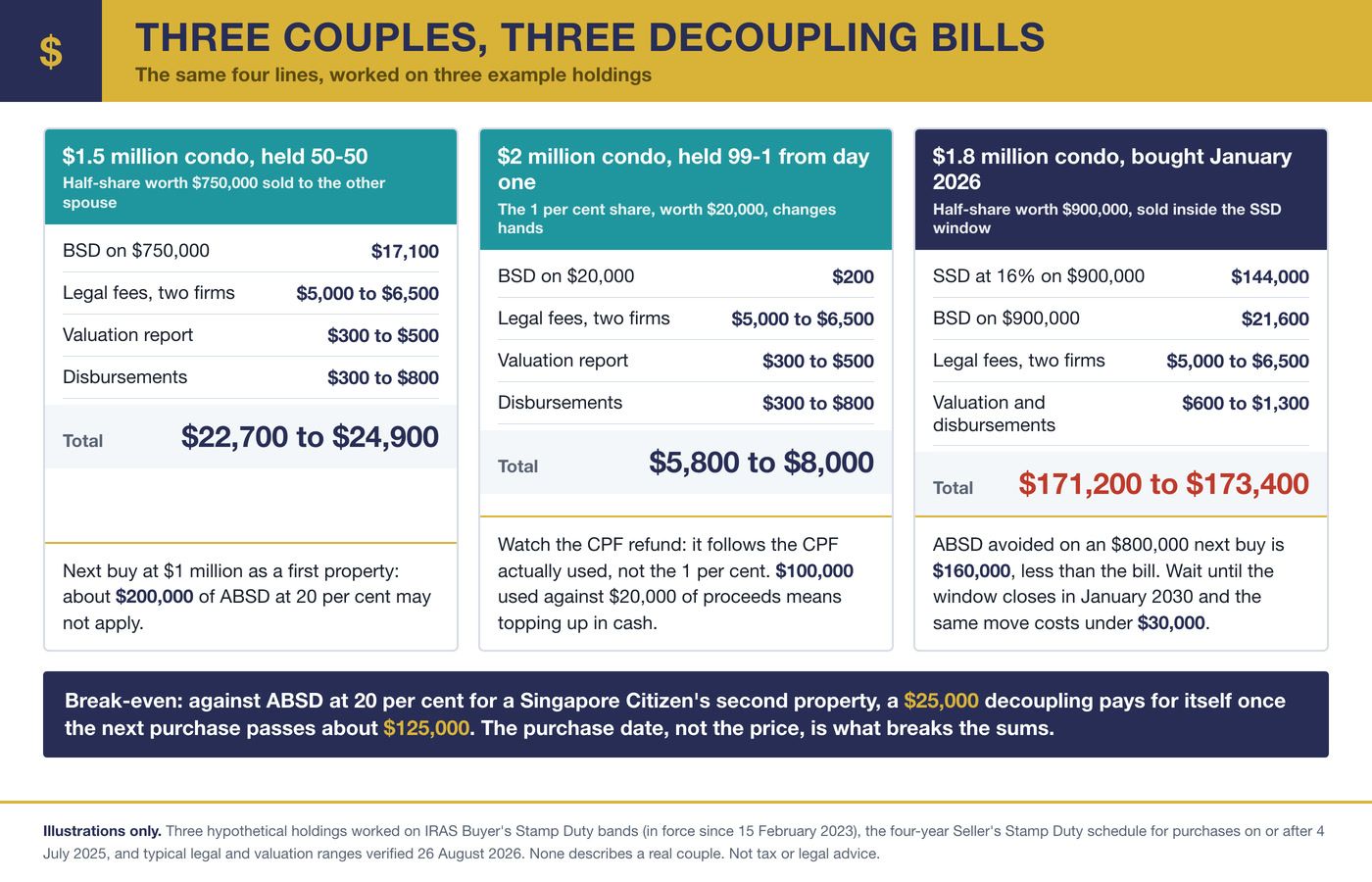
For example, let's say you and your spouse own a $1.5 million condominium equally. If you are transferring your 50 per cent share to your spouse, your share is worth $750,000.
Your spouse will then have to pay Buyer's Stamp Duty based on that $750,000 share. Here is your bill.
| Item | Amount |
|---|---|
| BSD on the $750,000 half-share | $17,100 |
| Legal fees, two firms | $5,000 to $6,500 |
| Valuation report | $300 to $500 |
| Conveyancing disbursements | $300 to $800 |
| Total | $22,700 to $24,900 |
For example, if you used $150,000 from your CPF savings to buy the home, plus another $28,000 in accrued interest, you would need to refund the full $178,000 to your CPF Ordinary Account when you sell your share. That refund comes out of your $750,000 sale proceeds.
The good news is that the $178,000 is not lost. Once it goes back into your CPF account, you can use it again for your next property purchase, subject to CPF rules.
Now for the saving. Once you have transferred your share and no longer own a residential property, your next purchase can be treated as your first property.
So, if you then buy a $1 million condominium as your only residential property, you may avoid the 20 per cent Additional Buyer's Stamp Duty, or ABSD, that a Singapore Citizen would otherwise pay on a second property.
That could save you around $200,000 in ABSD, compared with spending roughly $25,000 on the decoupling itself. That is the case for decoupling.
A $2 million condo held 99-1 from day one
Here's another example. Imagine you and your spouse bought a $2 million condominium with a 99-1 ownership split from the original purchase.
If you now transfer your 1 per cent share to your spouse, that share is worth $20,000. Your spouse would then pay Buyer's Stamp Duty based on the $20,000 share, which works out to just $200.
Here are your calculations.
| Item | Amount |
|---|---|
| BSD on the $20,000 share | $200 |
| Legal fees, two firms | $5,000 to $6,500 |
| Valuation report | $300 to $500 |
| Conveyancing disbursements | $300 to $800 |
| Total | $5,800 to $8,000 |
When we work through the numbers with a 99-1 couple, we look at the CPF statement first. That is because your CPF refund is based on what you actually used from CPF, not simply on your 1 per cent ownership share.
For example, if you had used $100,000 from your CPF, plus accrued interest, you would need to refund that amount when you transfer your share. But your 1 per cent share is only worth $20,000.
That means your sale proceeds may not be enough to cover the CPF refund. You may need to top up the shortfall in cash before the transfer can be completed.
There is one important thing you should be careful about with a 99-1 ownership structure. Setting up a 99-1 split when you first buy the property is perfectly legal.
The problem can come if you transfer the 1 per cent share to your spouse shortly after buying. If IRAS sees the transfer as an attempt to avoid paying stamp duty, it can treat the arrangement as tax avoidance.
That could mean you have to pay back the duty you saved, along with an additional surcharge. So if you are considering a 99-1 structure, make sure there is a genuine reason for the arrangement from the start, and do not treat it as a shortcut to avoid stamp duty later.
A $1.8 million condo bought in January 2026
Decoupling does not always make financial sense. The usual culprit is the SSD.
If you transfer your share while the property is still within the SSD period, the amount you have to pay can quickly eat into the savings you were hoping to get from decoupling.
For example, imagine you and your spouse bought a $1.8 million condominium in January 2026. You now want to decouple, by transferring your $900,000 share to your spouse.
Because the property was bought after 4 July 2025, it falls under the four-year SSD period. The rate is 16 per cent in the first year, followed by 12 per cent, 8 per cent and 4 per cent in the following years.
So if you transfer your $900,000 share within the first year, you could be looking at $144,000 in SSD alone. That is a big bill, and it can quickly wipe out any savings you were hoping to get from decoupling.
Here are the calculations.
| Item | Amount |
|---|---|
| SSD at 16% on the $900,000 half-share | $144,000 |
| BSD on the $900,000 half-share | $21,600 |
| Legal fees, two firms | $5,000 to $6,500 |
| Valuation and disbursements | $600 to $1,300 |
| Total | $171,200 to $173,400 |
Now the other side. If you plan to buy an $800,000 unit next, avoiding 20 per cent ABSD would save you $160,000.
But that is still less than the $171,200 to $173,400 you would spend on the decoupling itself. The SSD alone eats most of the saving before the legal fees and BSD even come in.
If you can wait until the SSD period ends in January 2030, the same decoupling could cost you less than $30,000 instead. That is a huge difference, so always run the numbers before deciding when to decouple.
Where the sums break even
Now for the break-even. If a typical decoupling costs around $25,000, you can compare that against the 20 per cent ABSD you would otherwise pay on your next property as a Singapore Citizen buying a second home.
At a 20 per cent ABSD rate, you would break even once your next property costs around $125,000. In other words, if you are buying a normal condominium, the potential ABSD saving is usually much higher than the cost of decoupling.
The real question is whether you qualify, and whether the timing and other costs make sense for you. On paper, a straightforward decoupling will usually pay for itself, but the purchase date can matter more than the property price.
When we look at a decoupling with you, we usually start with three simple checks. These will tell you whether the numbers actually work, whether you could be hit by SSD, and whether the potential ABSD savings are enough to justify the cost.
The SSD window. Look up your purchase date before anything else, because a Seller's Stamp Duty charge on the half-share can outweigh the entire ABSD saving, as you can see in the third example.
The solo loan. The remaining spouse must carry the refinanced mortgage on one income, so have a banker assess the numbers before paying any legal fees, because a failed refinancing leaves the costs spent with no decoupling completed.
The CPF position. Work out the exiting spouse's required CPF refund early, because a share worth less than the CPF used means finding the difference in cash.
Once you have cleared the exit side of the decoupling, you still need to think about how you will finance your next property. The rules are different when you buy again, so it is worth checking your borrowing limits and upfront costs before you commit.
Our guide to buying a second property in Singapore walks you through the numbers and what you need to plan for.
What couples ask when they run the numbers
Can we transfer the share for $1 to reduce the stamp duty?
No, because the Buyer's Stamp Duty is assessed on the higher of the price paid and the market value of the share. A $1 transfer of a $750,000 half-share is still stamped on $750,000.
Is the stamp duty charged on the whole property or just the share?
Stamp duty is only charged on the share changing hands. In a 50-50 decoupling of a $1.5 million home, the duty applies to $750,000, which is why the split chosen at the original purchase matters years later.
Does the CPF refund make decoupling more expensive?
No, the refund moves money from the sale proceeds back into the exiting spouse's own CPF Ordinary Account rather than to any third party. It can still create a cash shortfall when the share proceeds are smaller than the CPF used, as seen in a 99-1 holding.
We bought before July 2025, so which SSD rates apply to us?
Residential properties bought between 11 March 2017 and 3 July 2025 carry the older three-year Seller's Stamp Duty window, at 12, 8 and 4 per cent. A decoupling after the third anniversary of that purchase can proceed with no SSD at all.
Thinking of decoupling before your next purchase? The Prop.sg team can run these numbers on your actual holding, because the split, the CPF used, and the purchase date change the answer for every couple.
Related articles
All articles →
Is the En Bloc Premium Worth the Wait?
Should you sell your condo before an en bloc sale? How to price the 20 to 50 per cent premium against the years of waiting, the odds of failure and…
Read more →
How to Sell Landed Property in Singapore When No Two Houses Are Alike
Four ways a landed sale differs: harder valuation, a citizen-only buyer pool, land versus building value and longer marketing. Then the steps to…
Read more →
ABSD Remission for Married Couples (2026)
How a married couple gets the ABSD on a second home refunded: the conditions, when the six-month clock starts, and what happens if the sale falls…
Read more →