
ABSD Remission for Married Couples (2026)
Many married couples are already planning to buy their next home before the first one is sold. Before you do, you'll need to think about the Additional Buyer's Stamp Duty, or ABSD, which can cost a pretty penny.
If you're a Singapore Citizen and planning to buy a second residential property, ABSD is currently 20 per cent of the price or market value, whichever of the two is higher.
Fret not. If you buy your second home jointly with your spouse and at least one of you is a Singapore Citizen, you can claim a full refund of that ABSD by selling your first property within six months.
The ABSD refund comes from the Inland Revenue Authority of Singapore, or IRAS, under the spousal remission rules, and the conditions are strict. If you are relying on the refund, you need to get both the timing and the requirements right, or you're going to get hit with the full ABSD.
In this guide, we'll walk you through purely the remission rules, which include the conditions, the deadlines you need to meet, and what happens if the sale of your first home falls through.
For the bigger picture, including your loan limits, upfront costs and the ABSD rates on your next purchase, see our guide to buying a second property in Singapore. This page covers the remission only.
The upfront remission on a first matrimonial home
If you and your spouse have different residency statuses, such as one Singapore Citizen and one Permanent Resident or foreigner, you would normally pay ABSD when buying your first home together. The rate is based on the profile that attracts the higher ABSD rate.
The good news is that spousal remission can remove that ABSD in full, as long as you meet the remission conditions. So before you assume you have to pay the higher rate, check whether you qualify for the spousal remission.
To qualify, two conditions apply. The property must be bought in both names only, and neither spouse can own any other residential property.
You claim this remission when you stamp the documents through myTax Portal, so the ABSD does not actually leave your account in the first place.
The second property scenario works differently. There, you pay the ABSD upfront and only get the money back later if you meet all the remission conditions.
That difference can have a big impact on your cash flow, so plan for it.
Who qualifies for the second-property refund
Here are the conditions for the refund on a jointly purchased second home.
- You can still qualify if you and your spouse have different residency statuses. As long as at least one of you is a Singapore Citizen, a citizen married to a Permanent Resident or foreigner can still qualify for the remission.
- The property needs to be bought in your names as a couple only. If you add a parent, child or anyone else to the title, you will no longer qualify for the remission.
- On the date you buy the second property, neither you nor your spouse can own an interest in more than one residential property. In simple terms, each of you must own no more than one residential property at that point for the remission to apply.
- The ABSD was paid in full on the second property.
- You and your spouse must still be married when you sell the first property, and the ownership of your second home must remain unchanged. In other words, you cannot change the ownership structure of the second property before selling the first and still expect the remission to apply.
- You haven't bought any other residential property in between.
There is no such thing as a partial refund. It is all or nothing.
For example, if you buy a $1.5 million second home, the 20 per cent ABSD comes to $300,000. You need to pay that $300,000 within 14 days of signing the agreement.
The good news is that if you meet every remission condition and sell your first property within the required timeframe, you can get the full $300,000 back.
The six-month deadline, and when the clock starts
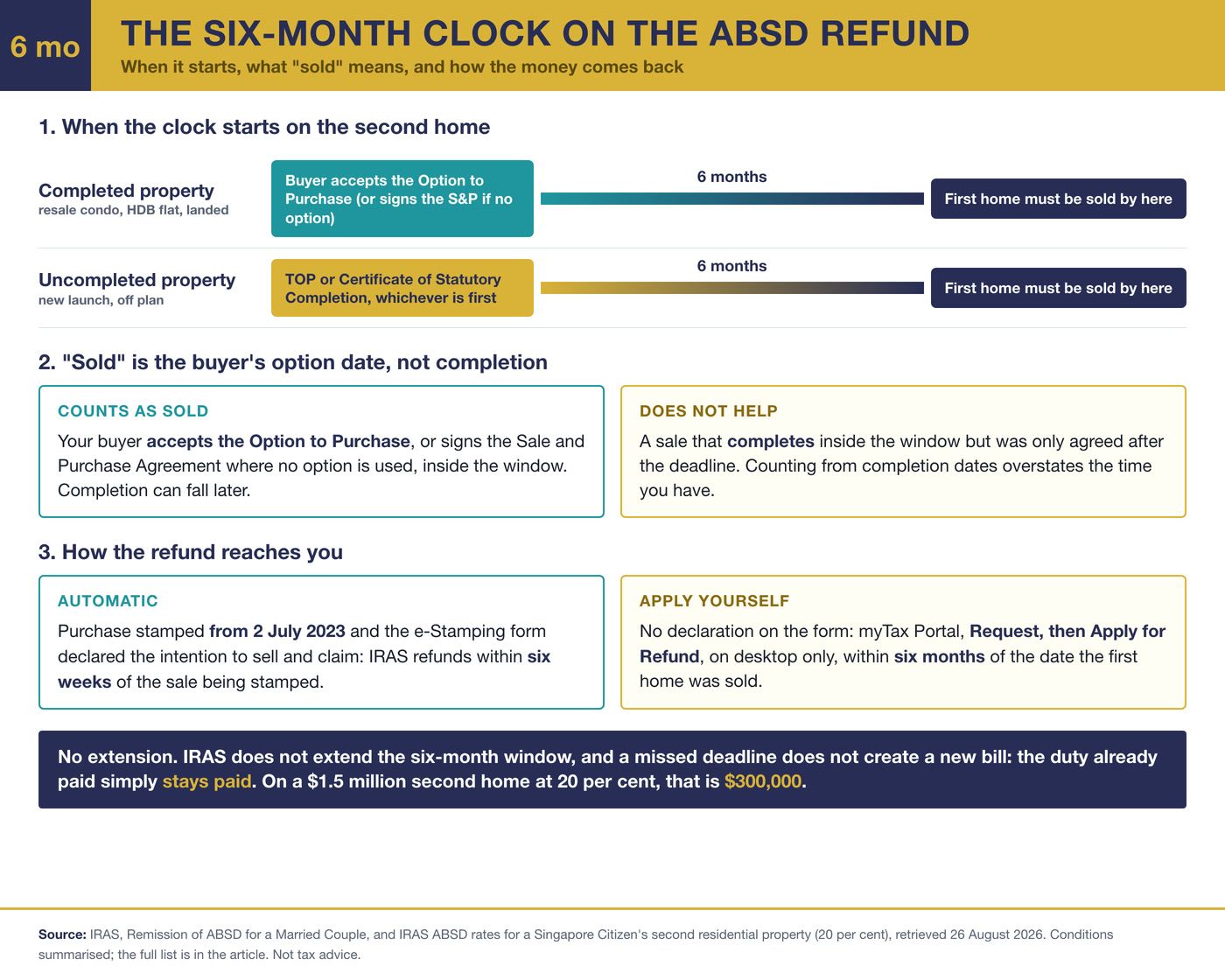
For a completed property, your six-month deadline starts from the date you accept the Option to Purchase for the second home. If there is no option, the clock starts from the date you sign the Sale and Purchase Agreement.
You then must sell your first property within that six-month window. If you miss the deadline, you may lose your entitlement to the ABSD refund.
If you are buying an uncompleted property, such as a new launch, the six-month clock works differently. It starts from the date the Temporary Occupation Permit, or TOP, is issued, or the Certificate of Statutory Completion, whichever comes first.
This gives you much more time compared with buying a completed property. You can sell your first home at any point before that deadline and still qualify, as long as you meet all the other remission conditions.
Sold has a fixed meaning here. For the six-month deadline, your first property is considered sold when your buyer accepts the Option to Purchase, or signs the Sale and Purchase Agreement if no option is used.
So you do not need to complete the sale within the six-month window. As long as you have signed the deal before the deadline, the sale can complete later.
When we map out the timeline with you, we count from the option dates on both sides. That gives you a more accurate picture of how much time you actually have.
If you count from the completion dates instead, you could end up thinking you have more time than you really do.
How the refund reaches you
For a refund, you may not even need to file a separate claim. For purchases stamped from 2 July 2023 onwards, if your e-Stamping form already states that you intend to sell your first home and claim the refund, IRAS can process the ABSD refund automatically.
Once you sell your first property and the sale is stamped, the refund is usually paid within six weeks.
If you did not make that declaration when you stamped the purchase, you will need to submit the refund request yourself through myTax Portal. Go to Request, then Apply for Refund.
Do not leave this too late. You need to submit the claim within six months of selling your first property, because after that the claim expires and you may lose the refund.
The myTax Portal service is available on desktop only. Before you assume the automatic refund applies to you, check your e-Stamping record from the original purchase.
That quick check can tell you whether you already declared your intention to sell the first property and claim the ABSD refund. If you did not, you will need to submit the refund request yourself.
If the sale falls through
Be very careful here. There is no extension on the six-month window.
IRAS has said it will not extend the timeline, and the one exception it ever made was a pandemic relief limited to second properties bought on or before 1 June 2020.
A collapsed or late sale doesn't create a fresh bill, because the duty was already paid at purchase. The money simply stays with IRAS, and in the example above, that's $300,000 that stays paid.
If your finances cannot comfortably handle paying the ABSD upfront, selling your first home before buying the next one is usually the safer option. Once you have sold your only residential property, you can buy your next home without paying ABSD.
IRAS also recommends that you start marketing your first property early and price it realistically. If possible, consider securing a buyer before you commit to your next home.
That way, you have a clearer idea of when your first property will be sold, and less risk of getting caught with a large ABSD bill.
Most of the risk comes down to one thing, which is getting your first home sold at the right price. When couples come to us late in the six-month window, the asking price is often what is holding everything up.
When we plan this move with you, we usually put your first home on the market before you sign the option for your second property. That gives you more time to find a buyer without rushing the sale.
Our guide to selling your property covers how to price your home properly. If you want someone to coordinate the whole move, our team can manage the sale and purchase together.
Give us a call before you sign anything, and we can help you plan the sequence from the start.
Questions couples ask about the refund
Can we claim the refund if one spouse is a foreigner?
Yes, you can. The rules ask for at least one Singapore Citizen spouse and a purchase in both names only, so a citizen married to a foreigner can qualify on the same terms as two citizens.
Do we have to pay the ABSD first and wait?
Yes. The ABSD on a second property is payable within 14 days of signing, and the refund is only returned after your first home is sold within the deadline.
When does the six-month period start for a new launch?
The six-month period starts from the issue of the Temporary Occupation Permit or the Certificate of Statutory Completion, whichever comes first. It does not start from the day you commit to the purchase.
You must sell your first property at any point before that deadline, or the ABSD stays paid.
What if we miss the deadline by a few weeks?
The refund may be refused if you miss the deadline, because IRAS does not typically extend the six-month timeline. Treat the deadline as fixed from day one.
Price your first property realistically from the start, because an overly ambitious asking price is often what causes a sale to drag past the deadline.
Related articles
All articles →
Is the En Bloc Premium Worth the Wait?
Should you sell your condo before an en bloc sale? How to price the 20 to 50 per cent premium against the years of waiting, the odds of failure and…
Read more →
How to Sell Landed Property in Singapore When No Two Houses Are Alike
Four ways a landed sale differs: harder valuation, a citizen-only buyer pool, land versus building value and longer marketing. Then the steps to…
Read more →
A Decoupling Calculator You Can Run on Paper
What a decoupling costs in Singapore, worked on paper: BSD on the share, two law firms, the valuation, and when SSD makes it fail. Three example…
Read more →