
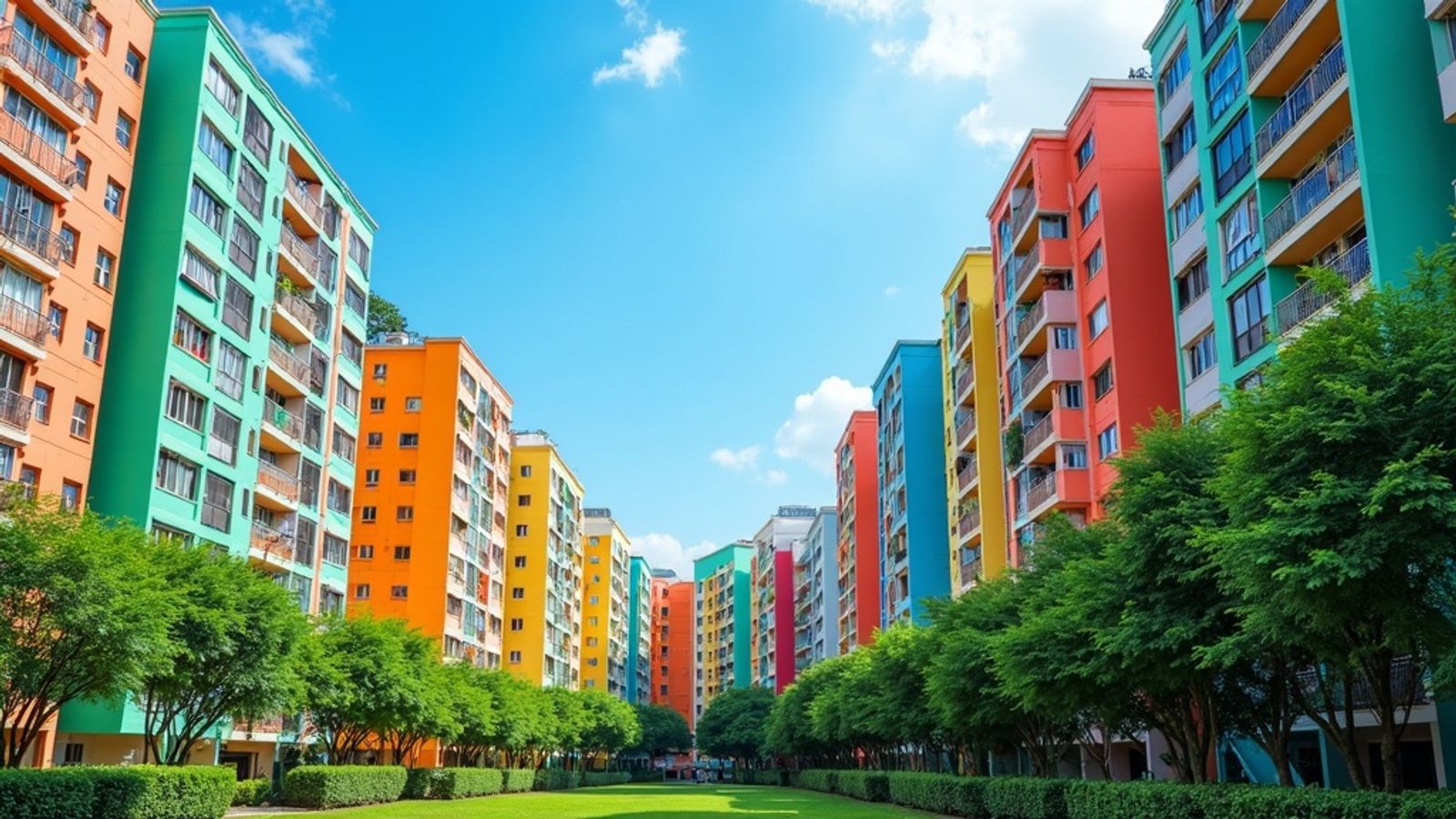
It's a question many homeowners have after hearing about HDB's buyback schemes in the news. And honestly, it's easy to see why there's confusion, as the name makes it sound like HDB is ready to take back your flat whenever you're done with it.
But in reality, HDB only buys flats back in three specific situations. Only one of these is something you can apply for directly.
For most homeowners, selling a flat still means finding another buyer through the open resale market.
The three ways a flat goes back to HDB
When we field this question, it usually turns out the owner means the first of the three.
The Lease Buyback Scheme is the one you can choose.
Owners aged 65 and above can sell part of their remaining lease back to HDB, continue living in their flat, and turn the value of that unused lease into retirement income. This is usually the scheme people are referring to when they ask about HDB buying back their flat, and we'll walk you through how it works in this guide.
SERS is the one that chooses you.
Under the Selective En bloc Redevelopment Scheme, the government takes back selected ageing blocks for redevelopment, pays compensation at market value, and provides rehousing options.
It is entirely government-initiated, and it has touched only a small number of sites in a decade. If your block is picked, the official announcement will be how you will know.
Surrender is the last resort.
In cases of serious financial hardship or a breach of conditions, HDB may, at its discretion, take a flat back.
Compensation in these cases typically sits below what the open market would pay. An owner in difficulty usually does better selling on the open market, and speaking to HDB early about options before things reach that point.
For everyone else, the buyer is another family on the resale market.
How the Lease Buyback Scheme actually works
When we walk owners through this scheme, the split is the part that matters, as this divides your lease into two.

You keep enough of the lease to stay in your home for life, while selling the remaining years back to HDB in exchange for a lump sum. The flat remains yours to live in throughout the retained lease period, and your day-to-day life in the home stays exactly the same.
How long you keep the lease depends on your age. The retained lease must cover the youngest owner until they turn 95.
For example, a 65-year-old owner keeps 30 years of lease and sells the remaining years back to HDB. A 75-year-old keeps 20 years, meaning more of the lease is sold, and a larger sum can be unlocked from the same flat.
Where the money goes, step by step
The money follows a fixed sequence, and the sequence matters more than the total headline sum. Proceeds first top up your CPF Retirement Account towards the Full Retirement Sum, which currently stands at S$205,800 in 2026.
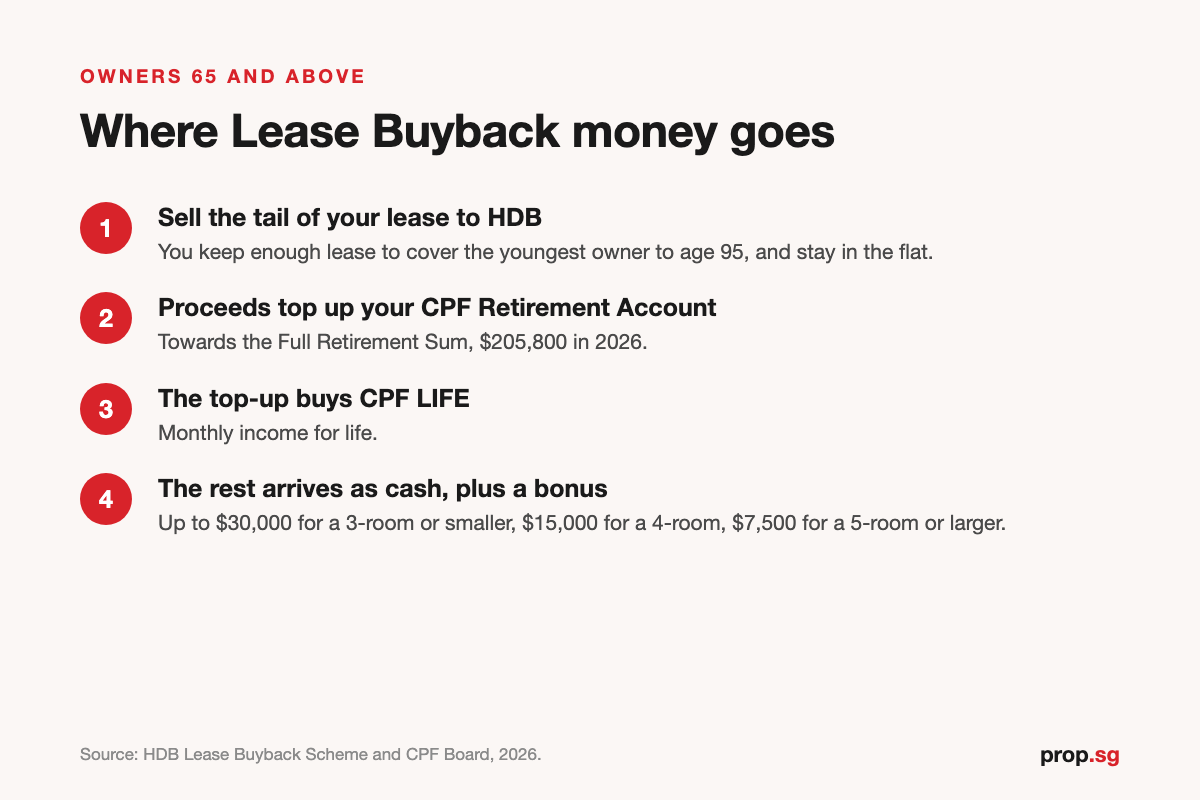
The CPF top-up then buys a CPF LIFE plan that pays a monthly income for life. A flat with 60 years left on the lease and an owner who needs 30 of them is the whole reason this scheme exists.
Whatever remains after the top-up comes to you in cash. HDB then adds a cash bonus on top, up to S$30,000 for a 3-room or smaller flat, S$15,000 for a 4-room, and S$7,500 for a 5-room or larger flat.
Owners with healthy CPF balances already near the Full Retirement Sum see more of the proceeds arrive as cash. Owners far from it see most of the money flow into the monthly income stream instead.
| Item | How it works |
|---|---|
| Who qualifies | All owners aged 65 and above, in a Singapore Citizen household |
| Flat types | All flat types, with the bonus tiered by flat size |
| Lease you keep | Enough to cover the youngest owner to age 95 |
| Where the money goes | CPF Retirement Account top-up first, remainder in cash |
| Cash bonus | Up to S$30,000 depending on flat size |
What the scheme is really trading
You're essentially turning lease years you're unlikely to use into retirement income that you can enjoy now. For homeowners who plan to stay in their flat for the rest of their lives, this can be a worthwhile trade-off.
The main thing to consider is what you give up in return. Once you join the scheme and set your retained lease period, the flat's remaining lease will continue to run down, and you can no longer sell it on the open market or pass it on to your children as a full property.
Because the decision is largely permanent, it's important to think beyond the immediate cash payout. If you might want to move in with your children, relocate overseas, or downgrade to another home in the future, that loss of flexibility could be the highest cost of the scheme.
You can still rent out spare rooms as long as you follow the usual HDB rules. However, what changes is your ability to exit, as selling the flat or leaving it as an inheritance is no longer an option.
Lease Buyback or sell and downsize?
When we help owners compare the two options, we look at them side by side. Selling on the open market means getting paid for the entire flat today, while the Lease Buyback Scheme lets you unlock value from part of the lease while continuing to live in your home.
An outright sale will usually give you more money upfront. But it also comes with trade-offs, including agent fees, the hassle of moving at an older age, and the challenge of finding your next home in the same market you're selling into.
The open-market numbers are also quite straightforward. In the past year, 10,395 four-room flats were resold at a median price of $630,000, while 5,515 five-room flats changed hands at a median of $740,000.
For example, a five-room flat owner who downgrades to a three-room flat could potentially unlock around $296,000 before costs, based on the median resale prices of $740,000 for five-room flats and $443,944 for three-room flats. That's the benchmark the Lease Buyback payout needs to be compared against.
| Flat type | Resales, past year | Median price |
|---|---|---|
| 3-room | 5,662 | $443,944 |
| 4-room | 10,395 | $630,000 |
| 5-room | 5,515 | $740,000 |
| Executive | 1,392 | $910,000 |
| Lease Buyback | Sell and right-size | |
|---|---|---|
| You move | No | Yes |
| What is sold | The lease tail only | The whole flat |
| Total unlocked | Smaller | Usually larger |
| Flat stays in the family | No, lease runs down | The new flat can |
| Reversible | Effectively no | You own the next home outright |
The better option depends on your own situation. For example, consider how much your flat can sell for, how much you value staying in your home, and how much CPF savings you already have.
It's worth running the numbers for both options before making a decision, and be cautious of anyone claiming there's only one "right" choice.
How the application actually runs
The process starts with an eligibility check against the age and citizenship rules. HDB will then walk you through a required financial counselling session before anything is signed.

The counselling session exists because joining the scheme is a permanent decision. During the process, you'll go through the trade-offs carefully, including the exact top-up requirements, bonus amounts, and cash figures based on your flat.
From application to completion, the process is mainly administrative. There's no need to find a buyer, prepare your home for viewings, or negotiate over price.
That's why the scheme appeals to owners who value certainty and peace of mind over getting the highest possible sale price.
What owners ask about selling back to HDB
Can I just sell my flat to HDB at market price?
No. Outside the Lease Buyback Scheme, SERS, and discretionary surrender cases, HDB does not buy flats back, and the open resale market is where a flat fetches its value.
Is there an age below 65 where Lease Buyback works?
No. All owners must be at least 65, and younger owners looking to unlock value are looking at right-sizing on the open market instead.
Will I get more from Lease Buyback or from selling and downsizing?
It all depends on your needs. Selling outright will get you more total value, but it also means moving.
The Lease Buyback Scheme will give you less, but it will also keep you in your home for life.
What happens if an owner outlives the retained lease?
The retained lease is planned to last until the youngest owner turns 95. If an owner lives beyond that period, HDB has stated that no one will be left without a home, and the next steps will be worked out together with HDB based on the individual situation.
Can I still rent out a room after the Lease Buyback?
Yes, the usual HDB rules still apply. The scheme only changes who holds the remaining part of the lease.
It does not change how you live in your flat day to day.
Can my children inherit the flat after the Lease Buyback?
Not as a full property. Once you join the scheme, the retained lease will continue to run down, and the flat can no longer be sold on the open market or passed down as a regular flat.
This is why owners who want to leave the property to their children often compare the right-sizing option first before deciding.
Does SERS still happen?
Rarely. Only a small number of sites have ever been selected, and the government announces each one formally.
Weighing Lease Buyback against selling on the open market? The Prop.sg team can help you do some number crunching on both options before you sign anything.
Related articles
All articles →
Is the En Bloc Premium Worth the Wait?
Should you sell your condo before an en bloc sale? How to price the 20 to 50 per cent premium against the years of waiting, the odds of failure and…
Read more →
How to Sell Landed Property in Singapore When No Two Houses Are Alike
Four ways a landed sale differs: harder valuation, a citizen-only buyer pool, land versus building value and longer marketing. Then the steps to…
Read more →
ABSD Remission for Married Couples (2026)
How a married couple gets the ABSD on a second home refunded: the conditions, when the six-month clock starts, and what happens if the sale falls…
Read more →