
How Long to Sell an Inherited HDB Flat
Inheriting an HDB flat can feel straightforward at first. It seems that all you have to do is receive the property, hire an agent who will find the buyer, and then complete the sale.

However, the timeline is a little trickier than that. You'll need the relevant paperwork, an eligibility check, and the HDB requirements in order.
A smooth case takes around six to twelve months from start to finish. The resale market itself moves faster than many expect, with more than 23,700 HDB flats changing hands across Singapore in the past year.
Where families often run into trouble are the deadlines. HDB has specific time limits that apply after an inheritance, including a twelve-month timeline and a six-month window that can catch owners off guard.
Knowing when these clocks start is the first step to avoiding unnecessary hiccups.
The five stages, and what each one takes
| Stage | What happens | Typical duration |
|---|---|---|
| Legal authority | Grant of Probate (with a will) or Letters of Administration (without) | Two to four months, longer if contested |
| Transmission at HDB | The flat moves from the deceased's name to the estate or a beneficiary | Weeks once the documents are in order |
| Decision point | Keep the flat, if someone is eligible, or sell it | Family-dependent |
| Marketing and sale | Ordinary resale process | One to three months to find a buyer |
| Completion | HDB resale completion | Around eight to twelve weeks |
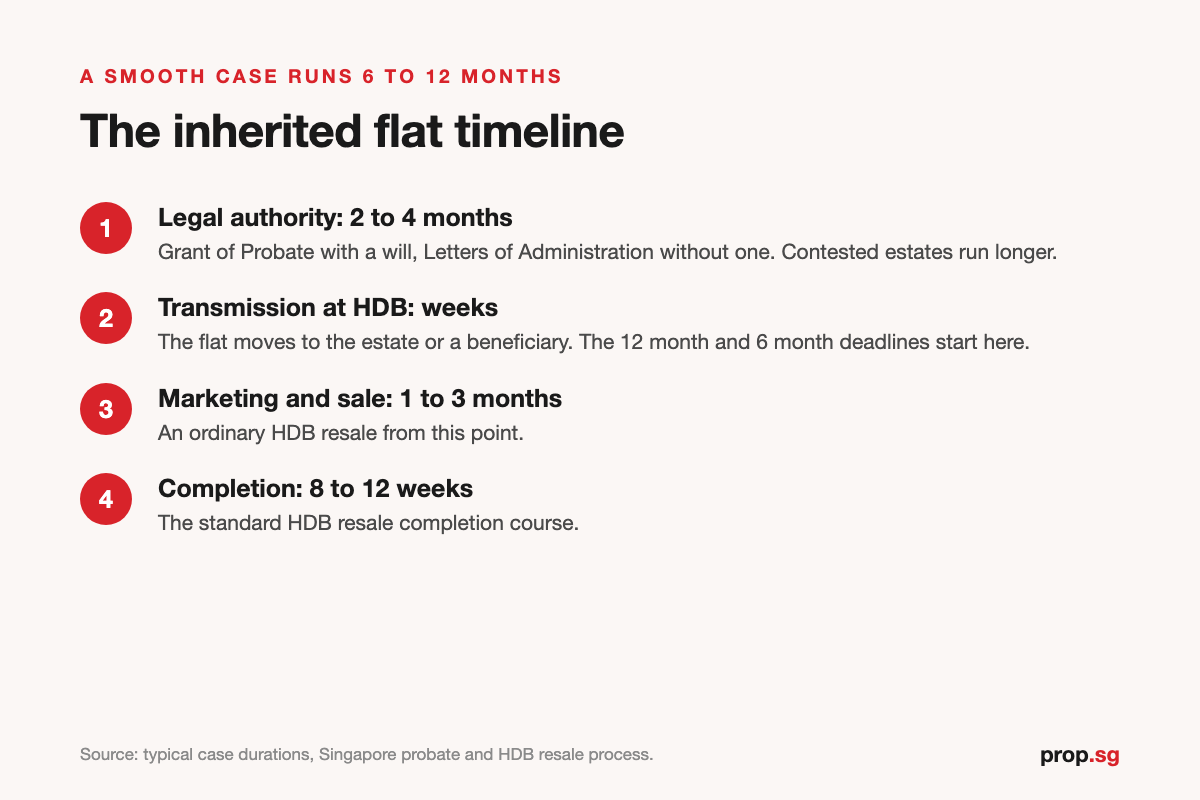
Put all those stages together, and six months is the optimistic estimate. However, if there are hiccups like contested estates, missing documents, or reluctant siblings, this process can stretch beyond a year.
Stage one, getting legal authority
Before an inherited HDB flat can be sold, someone must first have the legal authority to act on behalf of the estate. If there is a valid will, the executor applies for a Grant of Probate.
If there is no will, the family applies for Letters of Administration, and the distribution of the estate follows intestacy rules.
A straightforward application can be completed within a few months. However, things can take longer if the will is outdated, beneficiaries live overseas, or family members disagree about who should handle the estate.
In many cases, the biggest delays happen before the application even begins. Families often spend weeks gathering documents, locating information, and deciding who should take charge.
Starting this process early is one of the easiest ways to keep the overall timeline on track.

When we help families prepare the paperwork, the main documents are usually the same. The key items are the death certificate, the will if there is one, the flat's ownership details, and the deceased's CPF and HDB statements.
A probate lawyer can guide the family through any additional documents needed and clarify the next steps in one meeting.
Stage two, transmission, and the two deadlines
Once legal authority is granted, the flat can be transferred through HDB to the beneficiary or managed by the estate for sale. This is where many families discover an important difference: inheriting an HDB flat does not automatically mean you are allowed to keep it.
Whether a beneficiary can retain the flat depends on factors such as citizenship, family situation, and whether they already own other property. Two timelines are especially important.
The twelve-month clock
If nobody eligible can keep the flat, the estate is expected to sell it within twelve months from the transmission. Extensions may be possible, but leaving the matter unresolved for too long can create serious complications.
The six-month clock for owners with two HDB flats
If you already own an HDB flat that has passed the minimum occupation period, you may inherit another flat. However, you will need to decide which one to keep and sell the other within six months.
This decision is both emotional and financial. Family memories matter, but the numbers should also play a major role.
Beneficiaries who own private property have separate rules to consider, depending on when the flat was purchased. Getting advice from HDB or a conveyancer early can prevent costly misunderstandings.
How the flat was owned by the deceased also matters. Under joint tenancy, the share passes automatically to the surviving owner and does not follow the will.
Under tenancy in common, the deceased's share passes under the will and goes through the probate process.
Stage three, an ordinary sale with extra signatures
Once the ownership matters are settled, the sale itself follows the usual HDB resale process. The flat is priced based on recent transactions nearby, and the resale market is generally deep enough to support most homes.
In the past year, 10,395 four-room flats changed hands at a median price of $630,000, while 5,515 five-room flats sold at a median of $740,000.
Finding a buyer and reaching an agreed price takes one to three months in most cases. After that, HDB's resale completion process adds another eight to twelve weeks.
When we handle inherited flat sales, a few practical issues come up repeatedly. Clear the flat and settle outstanding bills early.
A poorly maintained home can affect buyer confidence, and unpaid utilities or service charges can create unnecessary delays.
It is also important for all beneficiaries to agree on the selling plan before the listing goes live. When multiple owners give different instructions during negotiations, buyers lose confidence, and deals can fall apart.
Where inherited sales actually lose time
The property market is rarely the reason an inherited flat sale gets delayed. More often, it is missing documents, unclear decisions, or family coordination issues that slow things down.
An executor living overseas, a beneficiary who is slow to sign, an unclear will, or simply putting things off can all add weeks or even months to the process. These delays are understandable, especially when families are dealing with loss, but they can affect the timeline significantly.
The best way to keep things moving is to make decisions early. If the family already knows that selling is the plan, the legal process and preparation of the flat can happen at the same time.
Starting both tracks together usually saves more time than trying to speed things up later.
What families ask about inherited flats
Is there a deadline to sell an inherited HDB flat?
Yes. If no eligible beneficiary is able to keep the flat, the estate is expected to sell it within twelve months of transmission, although an extension can be requested from HDB.
Separately, if a beneficiary inherits a second HDB flat while already owning one, they will need to sell one of the two flats within six months.
Can we sell before probate is granted?
No. Marketing can be prepared, but no binding sale can be completed without the Grant of Probate or Letters of Administration.
Does the flat's minimum occupation period apply to us?
The MOP that matters is the flat's own. A flat still inside its MOP raises additional questions with HDB, and the estate should settle its position before planning a sale.
Do we pay Seller's Stamp Duty on an inherited flat?
Inheritance itself does not trigger the seller's stamp duty. The estate's sale follows the normal rules, and HDB flats are, in practice, held past the relevant windows anyway.
What happens to the mortgage while the estate is sorted out?
The loan does not pause, and the estate keeps servicing it until completion, when the sale proceeds discharge it. Speak to the bank early if servicing is a strain, because lenders handle estate cases regularly.
What if one beneficiary refuses to sell?
The sale cannot move forward without the necessary approvals from all parties involved. Most disagreements are resolved through discussion or mediation, while more serious disputes may need to be settled through the courts.
Starting the conversation early is important. Resolving disagreements before finding a buyer avoids the risk of losing a deal after time and effort have already been spent.
Dealing with an inherited flat while managing everything else? Our complete guide to selling inherited property in Singapore also covers private properties.
When you are ready, the Prop.sg team can help handle the sale process while your family focuses on what matters most.
Related articles
All articles →
Is the En Bloc Premium Worth the Wait?
Should you sell your condo before an en bloc sale? How to price the 20 to 50 per cent premium against the years of waiting, the odds of failure and…
Read more →
How to Sell Landed Property in Singapore When No Two Houses Are Alike
Four ways a landed sale differs: harder valuation, a citizen-only buyer pool, land versus building value and longer marketing. Then the steps to…
Read more →
ABSD Remission for Married Couples (2026)
How a married couple gets the ABSD on a second home refunded: the conditions, when the six-month clock starts, and what happens if the sale falls…
Read more →