
How Soon Can You Sell Your Condo?
The idea of buying a property today and selling it shortly after for a quick profit sounds simple. In reality, property flipping in Singapore is not as straightforward as it looks.

While some owners do make gains from an early sale, costs, taxes, and market changes can quickly eat into the returns.
Technically, you can sell your condo as soon as you become the owner. Singapore does not impose a minimum holding period for private residential properties, so there is no rule requiring you to keep the home for a certain number of years before selling.
The biggest consideration is usually Seller's Stamp Duty (SSD). If you sell a private residential property within the SSD holding period, you may need to pay a percentage of the selling price as tax.
Under the current rules, properties bought on or after 4 July 2025 face SSD if sold within four years, with rates of up to 16 percent depending on how quickly you sell.
Before making an early exit, owners should also factor in loan costs, legal fees, agent fees, and whether the final selling price can actually deliver the profit they expect.
The two schedules
Depending on when you bought the property, you're required to pay a different level of SSD as follows. The date that matters is the date you exercised the option to purchase, or when you signed the sale and purchase agreement.
| You bought your condo | Holding period | SSD if you sell within |
|---|---|---|
| On or after 4 July 2025 | 4 years | Year 1: 16%, Year 2: 12%, Year 3: 8%, Year 4: 4% |
| Before 4 July 2025 | 3 years | Year 1: 12%, Year 2: 8%, Year 3: 4% |
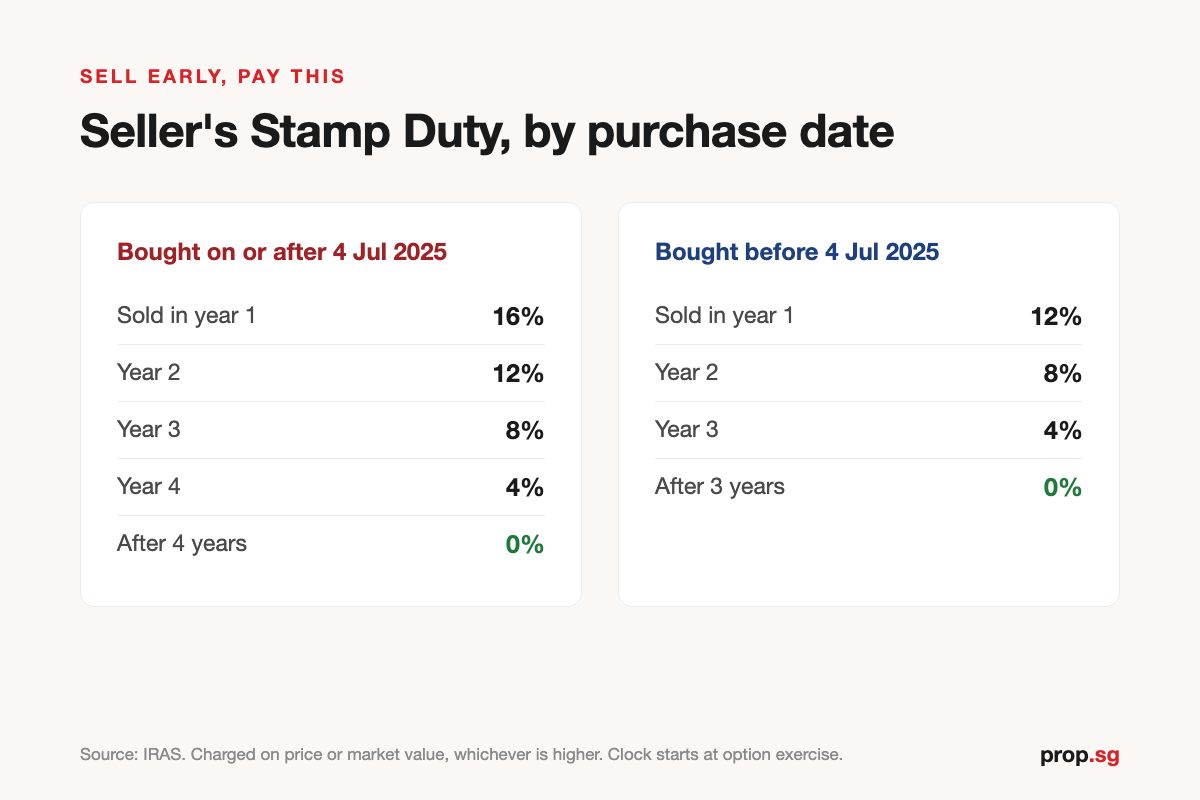
The duty is computed on the selling price or the market value at the time of sale, whichever is higher. You pay it as the seller, and you pay it even if you sell at a loss.
Once the holding period ends, you will not be subject to the SSD, and you can sell the property whenever you like.
What an early sale costs in dollars
Percentages hide the size of this tax. The tiers are cliffs.
On a $1.5 million condo bought after 4 July 2025, the SSD bill runs like this.
| Sold in | SSD rate | SSD on a $1.5m sale |
|---|---|---|
| Year 1 | 16% | $240,000 |
| Year 2 | 12% | $180,000 |
| Year 3 | 8% | $120,000 |
| Year 4 | 4% | $60,000 |
| After 4 years | 0% | $0 |
Under the older three year schedule, an owner selling the same $1.5 million property would pay $180,000 in Seller's Stamp Duty in the first year, $120,000 in the second year, and $60,000 in the third year. The 2025 changes extended the holding period to four years and increased the rate at every tier.
When we run these numbers with owners, the first year is usually where the reality hits. A property sold within the first year needs to gain more than 16 percent in value just to cover the SSD, even before adding agent fees, legal costs, and the Buyer's Stamp Duty already paid at purchase.
Once all those costs are included, a quick flip on a $1.5 million unit may need around a 20 percent price increase just to break even. The 2025 changes were designed to make short-term flipping for a quick buck much less attractive.
When your clock actually started

Your Seller's Stamp Duty (SSD) holding period starts from the date you exercised the Option to Purchase. The completion date and key collection date do not determine the clock, and this one date decides whether SSD applies if you sell.
When we check dates with new launch buyers, the surprise is often a good one. Someone who bought a unit at launch in 2022 and only collected the keys in 2026 has already been holding the property since 2022.
They may have cleared the SSD period by the time they move in.
The opposite happens with resale buyers. A unit bought in late 2025 may still be subject to SSD until late 2029, even if the owner originally planned to sell after only two years.
Before making any selling plans, find your exercised Option to Purchase and check the date carefully. Even a few days can make a difference because SSD rates change based on exact anniversaries.
Timing an exit around the tiers

Owners who need to sell early can still reduce the SSD impact with careful timing. The rates drop on the anniversary of the Option to Purchase date, so completing the sale just after the anniversary can mean paying a lower tier.
Using the $1.5 million example, moving from year one into year two reduces the SSD by $60,000. Waiting until after year four removes the final $60,000 charge completely.
The important date when selling is also linked to the Option to Purchase. SSD is assessed based on the date the buyer is granted the option, so sellers who are close to an anniversary may want to avoid granting the option too early.
When we help owners plan an early sale, we look at the timeline before discussing pricing. Valuation is also important because IRAS calculates SSD based on the selling price or market value, whichever is higher.
Selling below market value, especially to a related party, does not reduce the tax payable.
The exits that sit outside the tax
There are some ways that you can sell property and yet avoid the SSD. They are narrow, and each one turns on its exact paperwork.
Property passing on inheritance does not trigger the duty, and the beneficiary's own later sale is measured by the usual rules rather than being punished for the transfer. Transfers ordered by a court in a divorce follow their own track.
Bankruptcy-driven disposals sit outside the net as well. Public agencies acquiring land compulsorily do not create SSD bills for the owners they acquire from.
None of these carve-outs stretch to cover an ordinary sale that merely feels urgent. A job loss, an overseas posting, or a purchase that no longer fits the family all pay the full rate, which is why the timing work above matters most for exactly these cases.
Life-driven sales, and limiting the damage
Not every property sale can wait for the SSD clock to run down. Some situations, such as a divorce settlement, a death in the family, or serious financial pressure, require action regardless of the tax impact.
In these cases, the focus shifts from avoiding SSD completely to reducing the cost where possible. Three options can help: timing the sale around the SSD anniversary dates, renting out the property until the holding period ends, or, in divorce cases, considering how the transfer is handled under the court order.
Renting out the unit is worth considering before selling in the first or second year. Rental income can help cover holding costs while waiting for a lower SSD tier, and in some cases, the tax savings from waiting may outweigh the inconvenience of being a landlord for a period of time.
What selling actually looks like once the tax clears
Once SSD is out of the picture, a realistic calendar for a condo sale runs three to five months door-to-door. Here's a rough look at the timeline.
| Stage | Typical duration |
|---|---|
| Preparing the unit and the pricing | 1 to 2 weeks |
| Marketing until an acceptable offer | A few weeks to 2 months |
| Buyer's option period | 14 days |
| Exercised option to completion | 10 to 12 weeks |
The money arrives only upon completion, and sellers timing an onward purchase should plan around that final window.
Thin markets and ambitious pricing stretch the marketing stage, and nothing else. The legal timeline barely moves.
Does any of this apply to HDB flats?
Not usually. While Seller's Stamp Duty applies broadly to private residential properties, HDB flats have their own Minimum Occupation Period (MOP) rules that generally prevent owners from selling until they have met the required five-year period.
By the time most HDB owners are allowed to sell on the open market, the SSD window has already passed. This means HDB flat owners typically do not have to worry about SSD when planning their resale.
The owners who most often face SSD are private property buyers, including condo and private apartment owners who sell within the applicable holding period. Executive condominium owners can also be affected in certain situations, although the EC's own minimum occupation period usually means owners have already cleared the SSD timeline by the time they can sell.
What owners ask about selling early
Can I sell my condo after one year?
Yes, you can indeed. However, it means you'll have to pay 16 percent SSD under the current schedule, or 12 percent under the pre-July-2025 rules, so you'll have to factor that into your sales proceeds.
When exactly does my holding period start?
From the date you exercised the option to purchase or signed the sale and purchase agreement. Key collection and completion have nothing to do with it.
Is SSD charged on my profit?
No. It is charged on the full sale price or market value, whichever is higher, and you pay it even if you sell at a loss.
Can I avoid SSD by selling to a family member?
No. Selling a property to a family member does not automatically remove the Seller's Stamp Duty obligation.
If it is a transfer for value, it is treated as a sale, and IRAS can assess the transaction based on the market value if the stated price appears too low. The SSD rules still apply, so transferring the property within the holding period does not provide a way around the tax.
What if I am selling because of a divorce or a death?
Some situations, such as certain court-ordered transfers arising from a divorce or transfers due to inheritance, are treated differently from a normal property sale and may not fall under the usual SSD rules.
The details depend heavily on how the transfer is structured and the specific circumstances involved. Before making any assumptions, it is best to have a conveyancer review your situation and check how the rules apply.
Does renting the unit out pause the clock?
The clock never pauses and never needs to. Renting out the unit is simply how many owners carry a property to a cheaper tier instead of paying a year-one or year-two rate.
How long does a condo sale take after the SSD window?
Three to five months door-to-door for a smooth sale. Roughly 10 to 12 weeks of that sits between the exercised option and completion.
Working out whether to sell now or to hold? The Prop.sg team can help you work through the numbers, compare your options, and understand what makes the most financial sense.
The calculation is free, and there is no pressure to decide.
Related articles
All articles →
Is the En Bloc Premium Worth the Wait?
Should you sell your condo before an en bloc sale? How to price the 20 to 50 per cent premium against the years of waiting, the odds of failure and…
Read more →
How to Sell Landed Property in Singapore When No Two Houses Are Alike
Four ways a landed sale differs: harder valuation, a citizen-only buyer pool, land versus building value and longer marketing. Then the steps to…
Read more →
ABSD Remission for Married Couples (2026)
How a married couple gets the ABSD on a second home refunded: the conditions, when the six-month clock starts, and what happens if the sale falls…
Read more →