
How Long Does It Take to Sell an HDB Flat After a Divorce?
Divorce is tough enough. Then comes the awkward question: what happens to the HDB flat?

For many couples, it is the biggest asset they own, so selling it is not exactly something you can tick off the list and forget about.
The frustrating part is that there are two waiting games. First, you have to get through the divorce, which is difficult on its own.
Then you have to sell the flat. In a straightforward case, the divorce can take around four to five months to reach Final Judgment, followed by another three to six months to sell the flat.
If things get messy and the divorce is contested, the whole process can take much longer. Unfortunately, selling an HDB flat does not come with an express checkout lane.
This guide breaks down where all those months go, what the court order actually means, and how the Minimum Occupation Period (MOP) affects your options.
If you have already cleared the legal hurdles and are ready to sell, our guide to selling an HDB flat covers everything from pricing and marketing to the actual resale process.
The divorce paperwork sets the earliest date
A divorce in Singapore has two key stages. The court first grants an Interim Judgment, which dissolves the marriage, and then deals with the ancillary matters, which cover the division of assets, arrangements for the children, and maintenance.
The flat is decided at the ancillary stage. The Final Judgment can only be extracted at least three months after the Interim Judgment, and only once all the ancillary matters are resolved.
That wait is set by law, and no case skips it.
If both sides agree on everything before filing, the divorce can move pretty quickly. The Interim Judgment may come through in about a month.
After that, there is a three-month waiting period, which is why even a straightforward case usually takes around four to five months to reach the Final Judgment.
The good news is that you do not always have to wait for the Final Judgment before dealing with the flat. HDB can accept an application to change the flat's ownership from the Interim Judgment stage, as long as the arrangements for the flat and children have already been settled.
So, if you have a consent order, you can start sorting out the property months earlier.
There is still one important catch. The Final Judgment must be available before the sale is legally completed.
Starting early can save time, but it cannot make that final requirement disappear.
What the court order actually says
The court divides matrimonial assets in the proportions it considers just and equitable under the Women's Charter, and the flat is almost always a matrimonial asset. That is not a default 50/50 split, because the court weighs financial contributions, non-financial contributions such as childcare, the needs of the children, and the length of the marriage.
For the flat itself, the order will usually do one of three things. It may direct an open-market sale with the proceeds divided in stated proportions, it may direct one party to take over the other's share, or it may direct a surrender to HDB where no other route is open.
Orders that direct a sale usually set a deadline for it. You might want to read yours carefully before planning anything, because the deadline and the division formula in that document govern every step that follows.
The order can't override HDB's rules. A court direction to sell or retain still has to clear HDB's eligibility requirements before anything changes hands.
The MOP decides which door is open
The MOP, or Minimum Occupation Period, is the time all owners and essential occupiers must physically live in the flat before it can be sold on the open market. It's five years for standard flats and 10 years for Plus and Prime flats.
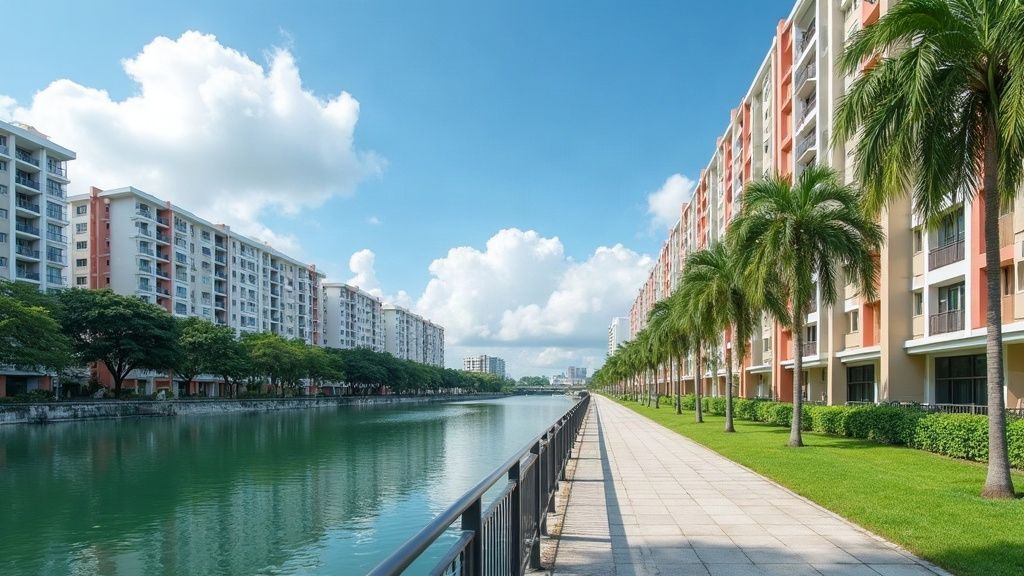
Divorce doesn't waive it. If your flat has fulfilled the MOP, the open market is available, and the timeline in this guide will apply.
If it has not, you may appeal to HDB for approval to sell early, and divorce is one of the situations HDB considers. Approval is assessed case by case, so keep a plan B in mind in case the answer is no.
If neither party can retain the flat and the MOP is unmet, the flat is usually surrendered to HDB at the compensation price that it sets.
That figure can be below market value and may even be below what you paid, which is why couples in this position often explore every other retention option first.
If one of you keeps the flat instead
Selling isn't the only route, and for a parent keeping the children's home stable, it is often not the preferred one. Whether you can retain the flat depends on HDB's schemes rather than on the court order alone.
A parent with care and control of the children may retain the flat as a Singapore Citizen meeting HDB's conditions, even below age 35 in some cases. Without children, retention generally runs through the Single Singapore Citizen Scheme, which requires citizenship and a minimum age of 35.
Being eligible is only part of the equation. If you want to keep the flat, you also need to make sure you can afford to take it over.
That usually means taking over the existing loan and refunding your ex-spouse's Central Provident Fund (CPF) money used for the flat, along with the accrued interest.
This is where your numbers really matter. Before you agree to anything or draft the consent order, work out whether you can comfortably handle the loan and CPF refund on your own.
If you cannot finance the takeover, your plan could fall apart after months of paperwork, leaving you back at square one and looking at a sale instead.
The sale itself, step by step
Once the court order is settled and your flat is eligible for sale, the process is pretty much the same as any other HDB resale. You first get the flat ready, decide on a price and put it on the market.
Once you find a buyer, the formal HDB resale process begins.
The part you cannot predict is how long it will take to find a buyer. The eight-week completion period is much more predictable.
If you price your flat well and it is in a popular estate, you could find a buyer within weeks. Price it too ambitiously, though, and you could be waiting for months.
If you are selling as part of a divorce, it is also worth agreeing on the price range with your ex-spouse before you list the flat. That way, when an offer comes in, you do not have to go back and forth getting approval from both sides before you can negotiate.
Once HDB accepts your resale application, completion usually takes about eight weeks. On completion day, the buyer pays for the flat, your outstanding loan is cleared, and the CPF money each of you used to buy the flat, including accrued interest, goes back into your respective CPF accounts.
Any remaining cash is then split according to what the court order says.

Before you finalise the court order, check exactly how much CPF needs to be refunded. A split that looks fair based on the selling price can look very different once both sides' CPF refunds are taken out.
There are also other costs to factor in, such as legal fees and the agent's commission. You can find a full breakdown in our guide to the costs of selling property in Singapore.
If your ex-spouse won't cooperate
Not all ex-spouses will be reasonable, especially during and after a divorce. Some HDB sales will be stuck as one party stops being responsive, disagrees, or refuses to sign.
It is messy and painful, but the law does provide a way out.
The Family Justice Courts can enforce the order in stages. They may draw adverse inferences against the non-cooperating party, appoint a valuer to fix the price, and in the strongest case authorise a court official to sign the sale documents on that party's behalf.
Enforcement adds time and legal costs, so treat it as the last resort rather than the plan. Thankfully, most cases never get that far.
When a sale gets stuck like this, the deadline in the court order often does more to get things moving than another round of convincing. In the meantime, keep your side of the paperwork ready.
If your ex suddenly changes their mind, you may have a small window to move quickly, so you do not want paperwork to slow you down.
What divorcing owners ask
Can I sell my HDB flat before the MOP because of a divorce?
Not automatically. You may appeal to HDB for approval to sell early, and if neither party is eligible to retain the flat, the likelier outcome is surrendering it to HDB at a compensation price HDB sets.
Do I need the Final Judgment before I can sell?
No, you do not have to wait for the Final Judgment to start the process. You can apply to HDB from the Interim Judgment onwards, as long as the arrangements for the flat and children have already been settled.
However, there is one important deadline. The Final Judgment must be ready before the sale is legally completed, so it needs to come through before the deal can close.
How are the sale proceeds split?
In the proportions your court order states, applied after the housing loan is repaid and each party's CPF principal plus accrued interest is refunded. The court aims for a just and equitable division, which may not necessarily be 50/50.
What happens if my ex-spouse refuses to sign?
The court can step in if your ex refuses to follow the order. In some cases, a court official can even be authorised to sign the sale documents on their behalf.
But there is a catch. Going down this route can take more time and add extra costs, so it is usually better to get both sides cooperating if you can.
Working through a sale after a divorce? Our team handles HDB sales with this paperwork sequence in mind, and we will tell you plainly whether your timeline is realistic.
Related articles
All articles →
Is the En Bloc Premium Worth the Wait?
Should you sell your condo before an en bloc sale? How to price the 20 to 50 per cent premium against the years of waiting, the odds of failure and…
Read more →
How to Sell Landed Property in Singapore When No Two Houses Are Alike
Four ways a landed sale differs: harder valuation, a citizen-only buyer pool, land versus building value and longer marketing. Then the steps to…
Read more →
ABSD Remission for Married Couples (2026)
How a married couple gets the ABSD on a second home refunded: the conditions, when the six-month clock starts, and what happens if the sale falls…
Read more →